

Introduction
Refrigeration technology has become an essential part of modern life and industry. From household refrigerators and air conditioning systems to pharmaceutical warehouses, cold storage facilities, food processing plants, supermarkets, hospitals, and industrial manufacturing processes, refrigeration systems play a crucial role in maintaining product quality, preserving materials, and ensuring operational efficiency.
Despite the wide variety of refrigeration equipment available today, most modern cooling systems operate based on the same fundamental principle known as the Vapor Compression Refrigeration Cycle. This cycle continuously removes heat from a low-temperature space and transfers it to a higher-temperature environment using a specialized fluid called a refrigerant.
Many people assume refrigeration systems create cold air. In reality, refrigeration systems do not create cold; they remove heat from an area where cooling is required and reject that heat elsewhere. Understanding this concept is fundamental to understanding how refrigeration systems operate.
This article explains the components, working principles, refrigeration cycle, equipment selection, applications, and maintenance requirements of modern refrigeration systems.
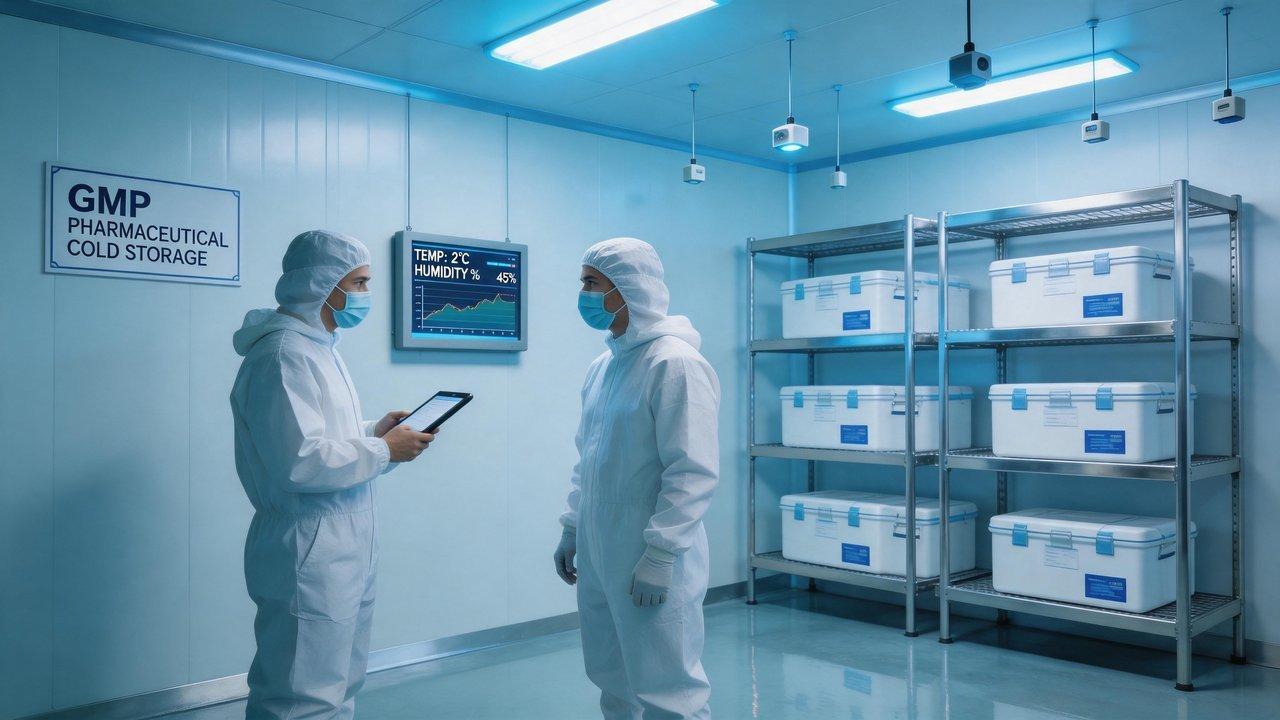
What Is a Refrigeration System?
A refrigeration system is a mechanical system designed to transfer heat from one location to another using a refrigerant circulating in a closed-loop circuit.
The primary objectives of a refrigeration system are:
- Lower temperature
- Preserve products
- Maintain process conditions
- Control humidity
- Improve product shelf life
- Support industrial processes
Virtually all commercial refrigeration and cold storage facilities operate using the vapor-compression refrigeration cycle consisting of evaporation, compression, condensation, and expansion processes.
Why Refrigeration Systems Are Important
Refrigeration systems are critical because they:
Preserve Food Quality
Prevent spoilage and bacterial growth.
Support Pharmaceutical Storage
Maintain vaccines, medicines, and laboratory materials within required temperature ranges.
Enable Industrial Processes
Many manufacturing processes require controlled temperatures.
Extend Shelf Life
Reduce product deterioration and waste.
Improve Operational Reliability
Maintain stable environmental conditions.
Without refrigeration technology, modern food distribution, healthcare, and industrial manufacturing would be significantly more challenging.
Basic Principle of Refrigeration
The refrigeration process is based on heat transfer.
Heat naturally moves from a warmer object to a colder object.
A refrigeration system forces heat to move from a colder space to a warmer environment by applying external work through a compressor. This process is made possible by the refrigerant, which continuously changes state between liquid and vapor.
The system continuously repeats four main processes:
- Evaporation
- Compression
- Condensation
- Expansion
These four processes form the refrigeration cycle.
Main Components of a Refrigeration System
Although refrigeration systems can vary in size and complexity, every vapor-compression refrigeration system contains four fundamental components.
1. Compressor
The compressor is commonly known as the heart of the refrigeration system.
Its functions include:
- Compressing refrigerant vapor
- Increasing refrigerant pressure
- Increasing refrigerant temperature
- Circulating refrigerant throughout the system
The refrigerant enters the compressor as a low-pressure vapor and leaves as a high-pressure, high-temperature vapor.
Common Compressor Types
- Reciprocating Compressor
- Scroll Compressor
- Screw Compressor
- Centrifugal Compressor
Compressor selection depends on refrigeration capacity, temperature requirements, and application type.
2. Condenser
The condenser removes heat from the refrigerant and rejects it to the surrounding environment.
As the hot refrigerant enters the condenser:
- Heat is released
- Refrigerant cools down
- Refrigerant changes from vapor to liquid
The condenser acts as the heat rejection component of the refrigeration cycle.
Common Condenser Types
Air-Cooled Condenser
Uses ambient air for heat rejection.
Water-Cooled Condenser
Uses cooling water.
Evaporative Condenser
Combines air and water cooling for higher efficiency.
3. Expansion Valve
The expansion valve regulates refrigerant flow into the evaporator.
Its functions include:
- Pressure reduction
- Flow control
- Temperature reduction
As refrigerant passes through the expansion device, pressure drops significantly, causing a corresponding decrease in temperature.
Common Types
- Thermostatic Expansion Valve (TXV)
- Electronic Expansion Valve (EEV)
- Capillary Tube
4. Evaporator
The evaporator is the component where cooling actually occurs.
Its functions include:
- Absorbing heat
- Cooling air or liquid
- Evaporating refrigerant
Inside the evaporator, the cold refrigerant absorbs heat and changes from liquid to vapor. This heat absorption produces the desired cooling effect.
Additional Refrigeration Components
Industrial refrigeration systems often include additional equipment beyond the four main components.
Refrigerant Receiver
Stores liquid refrigerant.
Filter Drier
Removes moisture and contaminants.
Sight Glass
Allows refrigerant inspection.
Accumulator
Protects the compressor from liquid refrigerant return.
Solenoid Valves
Control refrigerant flow.
Pressure Switches
Provide safety protection.
Control Panel
Manages system operation.
Sensors and Controllers
Monitor temperatures and pressures.
What Is Refrigerant?
A refrigerant is the working fluid that transfers heat throughout the refrigeration cycle.
Characteristics of a good refrigerant include:
- Low boiling point
- High heat absorption capacity
- Chemical stability
- Safe operation
- Environmental compliance
The refrigerant continuously changes state between liquid and vapor while transporting heat through the system.
Common Refrigerants
- R134a
- R404A
- R449A
- R507A
- R410A
- Ammonia (NH₃)
- CO₂ (R744)
The choice depends on system design and application requirements.
How a Refrigeration System Works
The refrigeration cycle operates continuously while the system is running.
Step 1: Heat Absorption in the Evaporator
Warm air or liquid passes over the evaporator.
The refrigerant absorbs heat and evaporates into a low-pressure vapor.
This is the point where cooling is produced.
Step 2: Compression Process
The low-pressure vapor enters the compressor.
The compressor:
- Raises pressure
- Raises temperature
- Creates refrigerant circulation
The refrigerant exits as a hot, high-pressure vapor.
Step 3: Heat Rejection in the Condenser
The hot refrigerant enters the condenser.
Heat is transferred to:
- Ambient air
- Cooling water
As heat is removed, the refrigerant condenses into a high-pressure liquid.
Step 4: Expansion Process
The liquid refrigerant passes through the expansion valve.
Pressure drops suddenly.
As pressure decreases:
- Temperature decreases
- Some refrigerant flashes into vapor
The refrigerant becomes a cold liquid-vapor mixture.
Step 5: Repeat the Cycle
The cold refrigerant enters the evaporator again.
The cycle continuously repeats.
This closed-loop process is responsible for all modern refrigeration systems.
High Side and Low Side of Refrigeration System
The refrigeration cycle is divided into two sections.
High Side
Includes:
- Compressor discharge
- Condenser
- Liquid line
Characteristics:
- High pressure
- High temperature
Low Side
Includes:
- Expansion valve outlet
- Evaporator
- Suction line
Characteristics:
- Low pressure
- Low temperature
Understanding these two sides is essential for troubleshooting and maintenance.
Applications of Refrigeration Systems
Refrigeration systems are used in numerous industries.
Cold Storage Facilities
Food preservation and frozen storage.
Pharmaceutical Warehouses
Medicine and vaccine storage.
Food Processing Plants
Production and packaging areas.
Supermarkets
Display refrigerators and freezer systems.
Ice Production Facilities
Ice manufacturing and storage.
Industrial Manufacturing
Process cooling applications.
Chiller Plants
Building cooling systems.
Data Centers
Equipment cooling applications.
Energy Efficiency Considerations
Energy consumption is one of the largest operating costs in refrigeration systems.
Efficiency improvements can include:
- Proper equipment sizing
- Variable Frequency Drives (VFD)
- High-efficiency compressors
- Advanced control systems
- Good insulation
- Preventive maintenance
Well-designed systems provide significant long-term energy savings.
Common Maintenance Requirements
To maintain reliable operation:
Compressor Inspection
Check vibration, oil level, and temperature.
Condenser Cleaning
Maintain heat transfer efficiency.
Evaporator Cleaning
Prevent airflow restrictions.
Refrigerant Leak Inspection
Ensure system integrity.
Electrical Inspection
Verify control system performance.
Pressure Monitoring
Confirm proper operating conditions.
Routine preventive maintenance improves reliability and extends equipment life.
Conclusion
A Refrigeration System is the foundation of modern cooling technology. Whether applied in cold storage warehouses, pharmaceutical facilities, food processing plants, supermarkets, industrial manufacturing, or HVAC systems, refrigeration equipment operates on the same fundamental vapor-compression cycle.
By combining compressors, condensers, expansion devices, evaporators, and refrigerants, these systems efficiently remove heat and maintain precise temperature conditions. Understanding the refrigeration cycle, equipment components, and maintenance requirements is essential for maximizing system performance, reliability, and energy efficiency.
At PT Karya Maja Utama (KMU), we provide complete Refrigeration Engineering Solutions including system design, cooling load calculations, equipment selection, cold storage installation, refrigeration piping, automation systems, testing & commissioning, and preventive maintenance services for commercial and industrial applications.
PT Karya Maja Utama
Your Trusted Partner for MEP & HVACR Solutions