
Introduction
In today's food, pharmaceutical, healthcare, logistics, and manufacturing industries, maintaining product quality throughout storage and distribution is critical. Many products are highly sensitive to temperature fluctuations and can quickly deteriorate if stored under improper conditions.
This is where a Cold Storage System becomes essential.
A cold storage system is a temperature-controlled facility designed to preserve products by maintaining specific environmental conditions. Unlike domestic refrigerators or commercial display coolers, cold storage facilities are engineered to handle large product volumes while maintaining stable temperatures for extended periods.
Cold storage systems are widely used to preserve fresh produce, frozen foods, seafood, meat, dairy products, vaccines, medicines, chemicals, and other temperature-sensitive products. Their primary purpose is not to create cold air, but to continuously remove heat from the storage area and maintain the required temperature range through a controlled refrigeration process.
This article explains the components, operating principles, temperature classifications, applications, and design considerations of modern cold storage systems.

What Is a Cold Storage System?
A Cold Storage System is a refrigerated storage facility designed to maintain products at a controlled temperature to extend shelf life, preserve quality, and prevent spoilage.
The system consists of:
- Refrigeration equipment
- Insulated room structure
- Temperature control system
- Air circulation system
- Monitoring and safety devices
Unlike standard air-conditioning systems, cold storage systems are designed to maintain temperatures ranging from positive chilled conditions to deep-freeze environments depending on the application.
Why Is Cold Storage Important?
Temperature control directly affects:
- Product quality
- Food safety
- Pharmaceutical integrity
- Inventory losses
- Regulatory compliance
- Customer satisfaction
Without proper cold storage:
- Food spoilage increases
- Pharmaceutical efficacy decreases
- Product shelf life shortens
- Financial losses increase
Modern cold chain operations rely heavily on properly designed cold storage systems to ensure product integrity from production to end-user delivery.

Types of Cold Storage Facilities
1. Chilled Room
Typical Temperature:
+2°C to +8°C
Applications:
-
Fresh vegetables
-
Fruits
-
Dairy products
-
Pharmaceuticals
-
Beverages
Chilled rooms maintain products above freezing while slowing bacterial growth and product degradation.
2. Freezer Room
Typical Temperature:
-18°C to -25°C
Applications:
-
Frozen food
-
Meat products
-
Seafood
-
Ice cream
Freezer rooms preserve products by significantly reducing biological and chemical activity.
3. Blast Chiller
Typical Temperature:
+90°C to +3°C
Rapid cooling process for:
-
Cooked food
-
Catering products
-
Food processing facilities
4. Blast Freezer
Typical Temperature:
-35°C to -40°C
Applications:
-
Seafood processing
-
Meat processing
-
Frozen food manufacturing
Blast freezers rapidly reduce product temperature to preserve texture, quality, and shelf life.
Main Components of a Cold Storage System
A cold storage facility combines refrigeration technology, building insulation, controls, and air distribution systems.
1. Compressor
The compressor is often referred to as the "heart" of the refrigeration system.
Its functions include:
-
Compressing refrigerant gas
-
Increasing refrigerant pressure
-
Circulating refrigerant throughout the system
Common compressor types include:
-
Reciprocating
-
Scroll
-
Screw
-
Centrifugal
The compressor drives the refrigeration cycle and enables continuous heat removal from the cold room.
2. Condenser
The condenser releases heat absorbed from the cold room to the surrounding environment.
Common condenser types:
Air-Cooled Condenser
-
Uses ambient air
-
Simpler installation
-
Lower initial cost
Water-Cooled Condenser
-
Higher efficiency
-
Suitable for larger facilities
The condenser converts high-pressure refrigerant vapor into liquid refrigerant.
3. Expansion Valve
The expansion valve controls refrigerant flow into the evaporator.
Its functions include:
-
Pressure reduction
-
Flow regulation
-
Temperature control
Common types include:
-
Thermostatic Expansion Valve (TXV)
-
Electronic Expansion Valve (EEV)
The expansion device is one of the four fundamental refrigeration-cycle components.
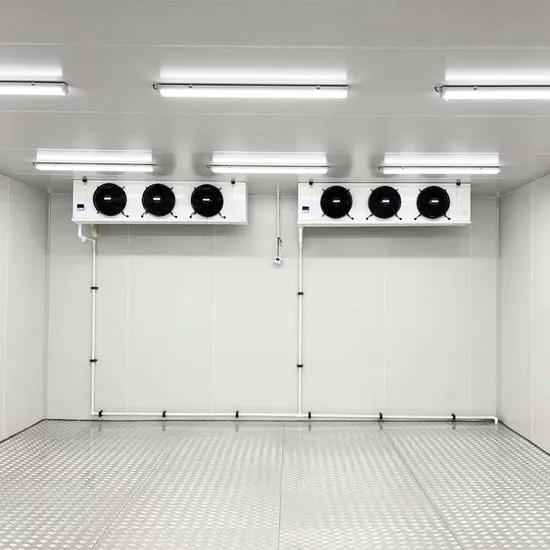
4. Evaporator
The evaporator is located inside the cold room.
Its primary functions are:
-
Absorbing heat from room air
-
Cooling the storage space
-
Maintaining target temperature
Fans circulate air through the evaporator coil to ensure uniform temperature distribution.
5. Refrigerant
Refrigerant is the heat-transfer medium circulating within the refrigeration system.
Its role is to:
-
Absorb heat inside the cold room
-
Transport heat through the refrigeration circuit
-
Release heat at the condenser
The refrigerant continuously changes state between liquid and vapor throughout the refrigeration cycle.
6. Insulated Panels
The room structure is typically constructed using insulated sandwich panels.
Common materials include:
-
PIR Panel
-
PU Panel
-
EPS Panel
-
Rockwool Panel
These panels minimize heat gain from the surrounding environment and improve energy efficiency. A typical cold room structure relies on insulated wall and ceiling panels together with specialized access doors.
7. Cold Room Door
Specialized cold room doors help:
-
Reduce air infiltration
-
Maintain room temperature
-
Improve energy efficiency
Features commonly include:
-
Thermal insulation
-
Heated frame (for freezer rooms)
-
Heavy-duty sealing gaskets
8. Control and Monitoring System
Modern cold storage facilities utilize digital control systems for:
-
Temperature control
-
Defrost scheduling
-
Alarm management
-
Data logging
-
Remote monitoring
Controllers continuously regulate refrigeration operation and protect stored products.

How a Cold Storage System Works
A cold storage system operates using the vapor-compression refrigeration cycle.
The objective is to remove heat from the storage room and reject it to the external environment.
Step 1: Heat Absorption by Evaporator
The evaporator absorbs heat from the room air.
As warm air passes over the evaporator coil:
-
Heat transfers to the refrigerant
-
Air temperature decreases
-
Cold air circulates throughout the room
Step 2: Refrigerant Evaporation
The refrigerant absorbs heat and changes from liquid to vapor.
This phase change enables efficient heat absorption.
Step 3: Compression Process
The compressor draws in low-pressure refrigerant vapor.
The refrigerant is compressed into:
-
High-pressure gas
-
High-temperature gas
This prepares it for heat rejection.
Step 4: Heat Rejection at Condenser
The hot refrigerant enters the condenser.
Heat is released to:
-
Ambient air
-
Cooling water
The refrigerant condenses into a high-pressure liquid.
Step 5: Expansion Process
The liquid refrigerant passes through the expansion valve.
Its pressure decreases rapidly.
As pressure drops:
-
Refrigerant temperature decreases
-
Refrigerant becomes ready for another cooling cycle
Step 6: Cycle Repeats
The refrigerant returns to the evaporator.
The cycle continuously repeats to maintain stable room temperatures. The refrigeration cycle consists of evaporation, compression, condensation, and expansion processes operating in a closed loop.
Air Circulation Inside Cold Storage
Temperature uniformity is essential.
Evaporator fans circulate air to:
- Prevent hot spots
- Maintain product quality
- Improve cooling efficiency
Proper airflow design is one of the most important aspects of cold room performance.
Key Design Considerations
A successful cold storage project requires:
Cooling Load Calculation
Accurate sizing of refrigeration equipment.
Product Type
Different products require different storage temperatures.
Panel Insulation Thickness
Depends on room temperature and ambient conditions.
Door Opening Frequency
Affects infiltration load.
Humidity Control
Critical for pharmaceuticals, fruits, and vegetables.
Temperature Monitoring
Required for food safety and pharmaceutical compliance.
Benefits of a Cold Storage System
Extended Product Shelf Life
Reduces spoilage and waste.
Improved Product Quality
Maintains freshness and integrity.
Regulatory Compliance
Supports HACCP, GMP, GDP, and food safety standards.
Reduced Inventory Losses
Protects valuable products.
Enhanced Supply Chain Reliability
Supports modern cold chain logistics.

Industries That Use Cold Storage Systems
Cold storage facilities are widely used in:
- Food Processing
- Frozen Food Manufacturing
- Seafood Processing
- Meat Processing
- Pharmaceutical Industry
- Vaccine Storage
- Beverage Industry
- Logistics & Distribution
- Agriculture
- Chemical Manufacturing
Common Maintenance Requirements
To ensure reliable operation, cold storage systems require:
- Refrigerant inspection
- Compressor maintenance
- Evaporator cleaning
- Condenser cleaning
- Defrost system testing
- Temperature calibration
- Door seal inspection
- Control system verification
Preventive maintenance significantly reduces downtime and operating costs.
Conclusion
A Cold Storage System is an essential component of modern food, pharmaceutical, healthcare, and logistics industries. By combining refrigeration technology, insulated structures, air circulation, and intelligent control systems, cold storage facilities maintain stable temperatures that protect product quality and extend shelf life.
Successful cold storage projects depend on proper cooling load calculations, equipment selection, insulation design, airflow management, and preventive maintenance. Whether the application involves chilled storage, freezer rooms, blast freezers, pharmaceutical warehouses, or industrial cold chain facilities, a properly engineered system delivers long-term reliability, efficiency, and product protection.
At PT Karya Maja Utama (KMU), we provide complete Cold Storage and Refrigeration Solutions including engineering design, cooling load calculations, equipment selection, insulated panel systems, refrigeration installation, automation, testing & commissioning, and preventive maintenance services for commercial and industrial applications.
PT Karya Maja Utama
Your Trusted Partner for MEP & HVACR Solutions